
Glass head-pendant
Glass head-pendant
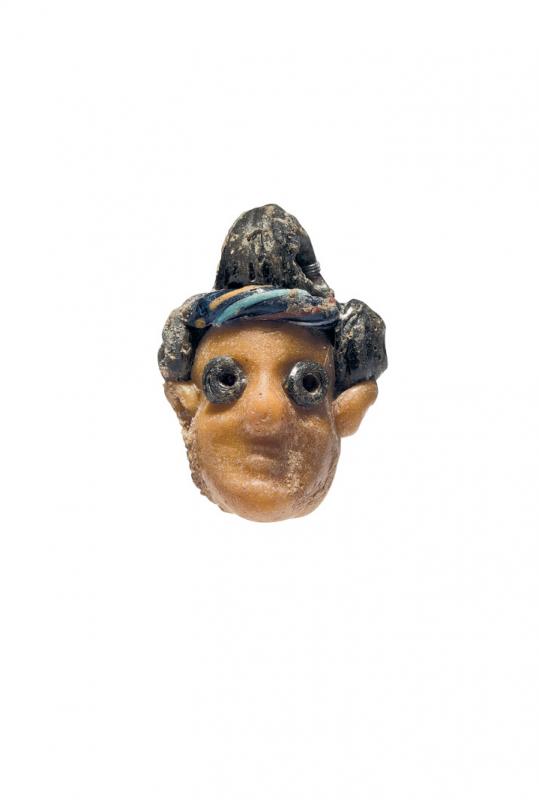
This female head is made of glass in different shades. The face is of yellow paste, while the eyes, the ears and the hairstyle have been modelled separately and joined with the face at a temperature of 800◦ C. The colours were achieved by using various oxides and metals. A loop on the hair was for suspension. The object was formed by the technique of drawing glass on a metal rod. Pendants made in this way are relatively rare. Similar objects are frequently found in graves and the suspension loop attests to their use as pendants or as central ornaments of a necklace. It has been suggested that these female heads, which are common in the Near East, render the goddess Astarte. The earliest pendants in the shape of a human head were fashioned in Egypt and the Levant in the 8th or 7th c. BC, and reached Carthage and other Phoenician colonies in the Western Mediterranean through Phoenician trading activity. Subsequently they began to be made in other regions too. The illustrated pendant is of a type produced in Cyprus, Rhodes and Alexandria between 300 and 150 BC. It may well be a creation of a local Cypriot workshop in which Phoenician glassmakers were employed. As is well known, there was a pronounced Phoenician presence on the island from as early as the 9th c. BC.